
How to Build a Web App in 2026: Real Cost, Stack & Timeline (From a Founder Who Ships)
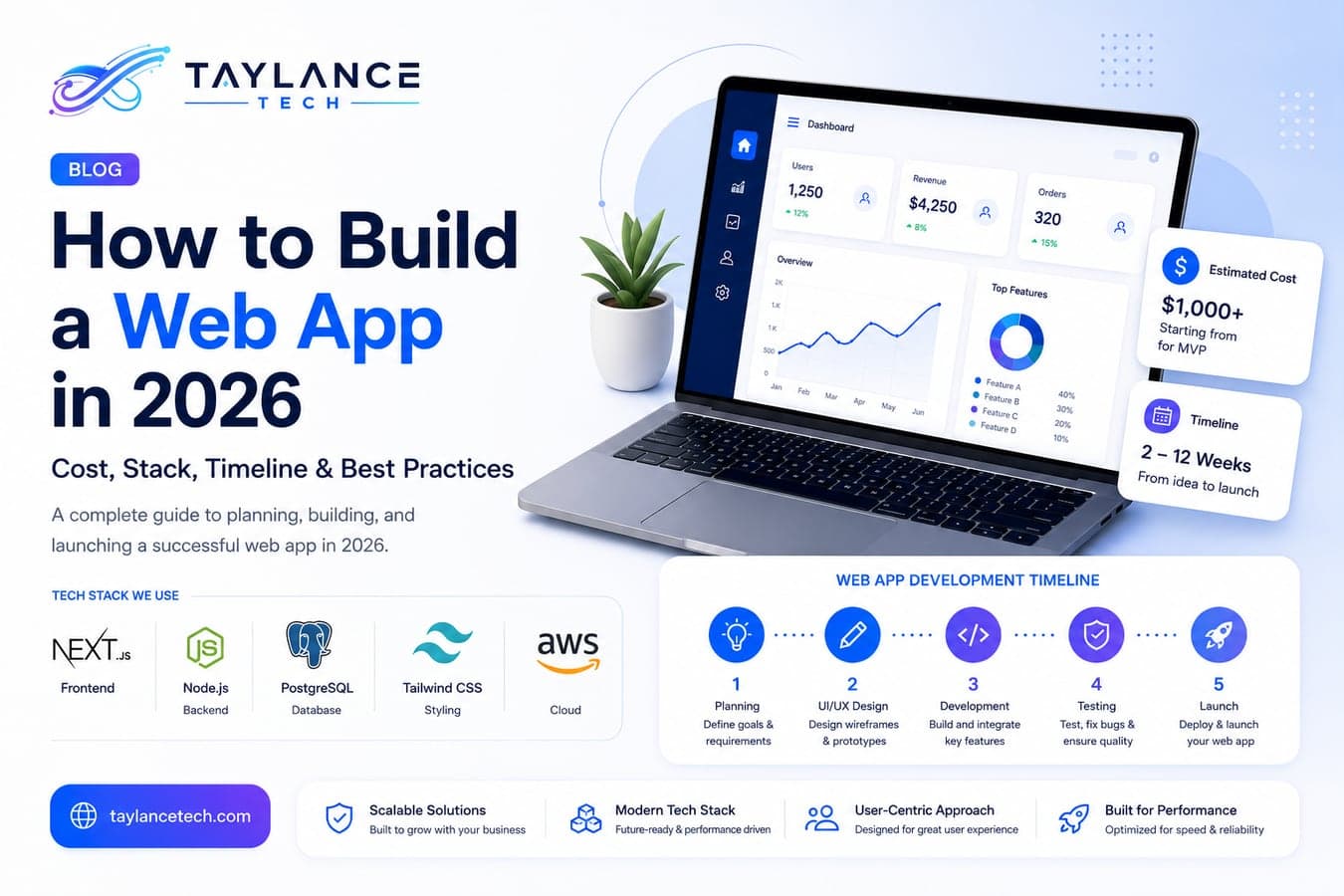
Updated May 30, 2026. Today we officially launched Taylance Tech — a founder-led software studio focused on web apps, SaaS products, and AI-powered workflows. Before launch, we shipped six production projects including Menu Order AI, 7Options, and Taylance CRM. This article shares the exact framework we use when founders ask: “How much does a web app cost, what stack should I pick, and how long will it take?”
Who this guide is for
This is written for startup founders, small business owners, and product teams who need a production-ready web application — not a demo that breaks after launch. If you are comparing agencies, freelancers, or an in-house hire, use this as a practical checklist.
- You want a SaaS MVP, client portal, or internal tool
- You care about SEO, performance, and maintainability
- You need honest timelines and budgets (not “2 weeks for any app”)
What “production-ready” actually means in 2026
A production web app is more than a UI in Figma. At minimum it includes:
- Authentication & roles — sign-up, login, password reset, protected routes
- Database & APIs — validated data layer, not hard-coded JSON
- Deployment — CI/CD, staging + production, error monitoring
- Security basics — HTTPS, input validation, rate limits, secure env vars
- Performance — Core Web Vitals, image optimization, caching where it matters
- SEO foundation — metadata, sitemap, structured data, indexable pages
Skipping any of these is how projects end up “live” but invisible to Google, slow on mobile, or impossible to extend.
Recommended tech stack for new web apps (2026)
There is no universal stack, but for most SaaS and marketing-led products we recommend:
Frontend: Next.js + React + TypeScript
Next.js remains the strongest default for SEO-heavy apps because server rendering and static generation improve discoverability and first-load performance. TypeScript reduces regressions as features grow.
Backend & database: Supabase or Node + PostgreSQL
For MVPs, Supabase (PostgreSQL + auth + storage + RLS) accelerates delivery without locking you into a proprietary backend. For complex billing or custom APIs, Node/Express with a managed Postgres instance still works well — we used both on recent projects.
Payments & subscriptions
If you sell online, plan Stripe integration early (webhooks, failed payments, customer portal). On 7Options we integrated Stripe subscriptions, refundable deposits, and CRM sync — payment edge cases often take longer than the checkout UI.
AI features (when they add real value)
LLM features belong where they save measurable time — menu scanning, document extraction, support triage — not as a buzzword badge. See our AI & automation services for practical patterns.
Realistic web app cost ranges in 2026
Prices vary by scope and who builds it. These ranges reflect what we see on founder-led and boutique studio engagements (USD, remote delivery):
| Project type | Typical scope | Indicative budget | Timeline |
|---|---|---|---|
| Landing + lead capture | 5–8 pages, CMS or static, SEO setup | $2,000 – $6,000 | 2–4 weeks |
| Marketing site + blog | Content system, admin, analytics | $4,000 – $10,000 | 3–6 weeks |
| SaaS MVP | Auth, core workflow, admin, billing | $15,000 – $45,000 | 8–16 weeks |
| Custom internal CRM / ops tool | Roles, dashboards, integrations | $12,000 – $35,000 | 6–12 weeks |
| AI-powered product feature | Model integration, guardrails, UI | $5,000 – $20,000+ | 3–8 weeks (add-on) |
Red flags in quotes: fixed price with no discovery phase, no mention of hosting costs, or “unlimited revisions.” Good partners scope phases and define what “done” means per milestone.
Timeline breakdown: 8-week SaaS MVP example
- Week 1 — Discovery: goals, users, must-have vs nice-to-have, success metrics
- Week 2 — UX flow: wireframes for core paths (signup → activation → paywall)
- Weeks 3–5 — Build sprint: auth, database schema, core features, admin basics
- Week 6 — Integrations: Stripe, email, analytics (GA4), error tracking
- Week 7 — QA & performance: mobile testing, Lighthouse, security pass
- Week 8 — Launch: production deploy, monitoring, handoff docs
Menu Order AI’s QR scanner and companion site shipped in roughly seven weeks because the problem was tightly defined. Scope creep is the main timeline killer — not “which framework you pick.”
SEO: build traffic from day one
Many apps launch with a single landing page and zero indexable content. That makes paid ads the only channel. Instead:
- Publish 1–2 pillar articles (like this one) targeting buyer-intent keywords
- Ship a sitemap.xml, canonical URLs, and JSON-LD on key pages
- Use semantic HTML (one H1 per page, logical H2/H3 structure)
- Keep Core Web Vitals green — Google uses page experience signals
Our SEO service line focuses on technical SEO plus content that matches what your buyers search — not keyword stuffing.
Common mistakes founders make
1. Building every feature before validating one workflow
Ship the smallest loop that proves value. Add dashboards and nice-to-have modules after real usage.
2. Choosing stack for résumé appeal
Your stack should optimize for hiring, hosting cost, and speed — not Twitter trends.
3. Ignoring maintenance
Budget 10–20% of build cost annually for dependencies, security patches, and small enhancements.
4. Fake social proof
Testimonials and case studies should reflect real work. Our portfolio links to live apps you can test yourself.
Founder-led vs large agency: what to expect
Large agencies bring process and bench depth; founder-led studios bring direct access to the person writing code and making architecture calls. For early-stage products, direct communication often beats layers of account managers — provided the studio has shipped real production apps. Ask for live URLs, GitHub samples (if applicable), and a clear statement of who builds your product.
FAQ
How much does it cost to build a web app in 2026?
Most serious MVPs fall between $15,000 and $45,000 for a first production version. Marketing sites and blogs are lower; enterprise integrations push higher.
How long does web app development take?
Expect 8–16 weeks for a focused SaaS MVP with auth, core features, and deployment. Simple sites can ship in 2–6 weeks.
Is Next.js still good for SEO in 2026?
Yes. Server-rendered and statically generated pages still outperform client-only SPAs for organic discovery when configured correctly.
Should I hire offshore developers?
Remote teams can deliver excellent work if communication, timezone overlap, and code quality standards are clear. Location matters less than track record and transparency.
What should I prepare before contacting a developer?
One-page brief: problem, target user, 3–5 must-have features, budget range, desired launch date, and examples of products you like.
What we are building at Taylance Tech
We officially launched today as a founder-led studio based in Faisalabad, Pakistan, working remotely with clients worldwide. We design and build:
- Web applications & SaaS platforms
- AI-powered workflows (menu intelligence, automation, integrations)
- SEO-focused sites that rank and convert
Browse our case studies or start a conversation if you want a honest scope review for your next project.
— Tayyab Aslam, Founder & Lead Developer, Taylance Tech